Still Her Brother
The emergency review took place three days later in the family division, where Maya’s custody docket and Caleb’s separate child-safety docket were coordinated without being treated as the same case.
The judge explained that the hearing concerned immediate safety and temporary access, not final custody, criminal guilt, or either family’s permanent future.
Rebecca sat with her attorney while Maya waited outside with a court child specialist.
Teresa sat behind Caleb’s appointed child advocate.
Eric and Lauren sat at opposite ends of the other table.
The agency submitted the emergency-department record, the safety plan, written summaries of the two recorded child interviews, Caleb’s text, and preserved copies of both phone videos.
No one asked Maya or Caleb to testify.
The judge reviewed the materials and asked the adults direct questions.
Lauren answered first.
She said Maya had become defiant during visits.
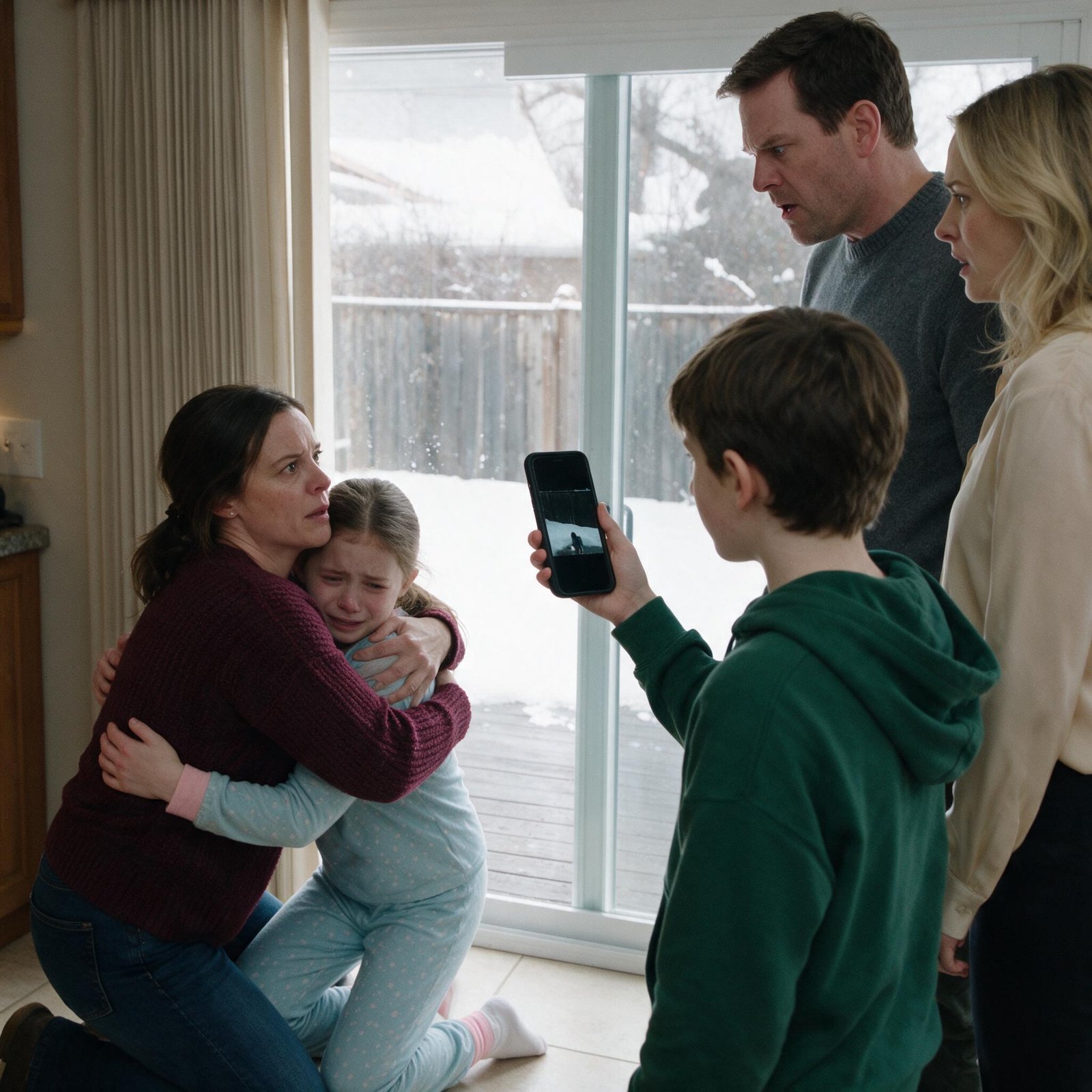
She said the patio was visible from the kitchen and the door was only a few steps away.
She said a consequence stopped working if a child learned that crying could end it.
Her lawyer reminded her that the court had asked about duration.
Lauren admitted that the first five-minute timer had sounded.
She admitted keeping the door closed because Maya had not become quiet.
She admitted sending Maya outside again the next morning.
“It was controlled, Your Honor,” Lauren said, as if adding one letter made the act safer.
The judge asked whether she understood that Maya was six, wearing pajamas and socks, and standing on a snow-covered patio.
Lauren replied that she had been watching through the glass.
The judge wrote something down.
Eric’s attorney began by distinguishing what Eric had approved from what Lauren had done.
Eric interrupted him.
He admitted approving the first outside reset.
He admitted instructing Caleb to run the timer.
He admitted hearing the alarm and Caleb’s warning that Lauren had not opened the door.
He admitted deciding not to interrupt his work call.
He also admitted ordering Caleb to keep the incident from Rebecca.
Finally, he admitted telling Caleb that being his son meant protecting the family that had chosen him.
The judge asked what Eric had known on Saturday morning.
Eric said he had entered the kitchen before Rebecca, seen Maya through the glass, and let Lauren’s second reset continue because he assumed it would end at five minutes.
Then, instead of checking Maya when Rebecca brought her inside, he had defended Lauren and tried to hold Rebecca back.
The judge asked why.
“Because admitting Rebecca was right meant admitting what I had allowed,” Eric said.
It was the truth, but it did not purchase forgiveness.
The judge said Eric’s distinctions mattered to the final facts, but they did not make him protective.
A parent who approved a dangerous punishment, ignored its limit, assigned one child to supervise it, and ordered secrecy had made the harm possible.
The temporary order gave Rebecca sole physical custody of Maya pending a fuller evaluation.
Lauren would have no direct or indirect contact with Maya.
Eric would have no unsupervised contact, and any therapeutic visit would begin only after Maya’s clinician and child advocate agreed she was ready.
Both adults were barred from using Caleb to carry messages or gather information.
The judge left Caleb’s emergency kinship placement with Teresa in place while the child-safety agency and juvenile court completed their separate review.
Lauren’s contact with Caleb would be supervised.
Eric’s contact would also be supervised because his secrecy order had placed Caleb inside the harm.
The judge made clear that none of those terms was final.
The investigation remained open, and the parties would return after evaluations and a fuller evidentiary hearing.
Lauren whispered that everyone was treating a parenting technique like abandonment.
The judge heard her.
“Calling it a technique does not warm a child,” she said.
Eric accepted the temporary terms without asking the court to excuse him again.
There was no hallway apology and no scene in which one honest admission repaired two frightened children.
The child advocate raised one last issue.
Caleb and Maya had lived as siblings for years, and separating their homes should not turn safety into another punishment.
Rebecca and Teresa agreed to scheduled video calls, weekend visits at Teresa’s home, and transportation that required neither child to see Eric or Lauren.
With the child advocate’s support, Rebecca and Teresa incorporated direct sibling contact into both temporary safety plans unless either child’s specialist recommended a pause.
That evening, Rebecca brought Maya to Teresa’s house for the first visit.
Caleb had placed two mugs of cocoa on the coffee table and left the curtains open to the snowy yard.
Maya stopped at the threshold when she saw the glass.
Caleb crossed the room and closed the curtains without asking her to explain.
They sat on the rug with a deck of cards while Rebecca and Teresa completed the safety-plan calendar.
Caleb did not promise that everything would return to normal.
He showed Maya the nights they could call and her name written beside every one.
When it was time to leave, Maya held his sleeve with both hands.
She looked from Caleb to Rebecca, trying to understand how a court could move a person without moving his place in her life.
“Can Caleb still be my brother if he lives somewhere else—”
Part 4 of 5 · He Said It Was Only Five Minutes